Saturday, January 17, 2009

Snow Laden Roses - Boughed But Not Beaten

By Guest Writer Terri Clark

World Rose Convention city, Vancouver, is known for its temperate climate where extremes are usually reached only at the upper altitudes. Back in the early 1970s, the precursor organization to Tourism Vancouver used to famously tout that when you visited our “city beautiful”, you could golf in the early morning, sail at lunchtime and ski in the afternoon. Such was our ordained Camelot, weather-wise at least.

So too for avid gardeners who realized that Zone 8 plants could edge their way through a Vancouver winter given a little TLC, or at the very least good drainage, so often the key to survival in a wet but cold climate.

But Mother Nature rules in the end and even before winter had fully been declared, she started thumping evergreen Vancouver with innumerable substantial snow storms pre and post Christmas 2008.

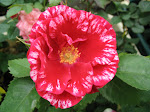
Our family had escaped to New England for the holidays and upon our return two weeks later, could nary recognize a rose bush in the garden due to thick layers of snow and ice that had face-planted them earth-side. The elegant and ruby-coloured arms of my most prized Rosa mutabilis, hard to find commercially, was totally prone as were so many others. Fortunately for me, early November had seen major pruning of my climbing rose with sturdy ties holding them skyward.

But what to do with the flattened rose canes? Experience has taught me that time does heal many wounds especially where actual “breaks” have not occurred. The snow is gradually melting now and I have assessed the damage. Broken canes or splits have been cleanly pruned back to just below the injury and boughed ones staked up until their “strength” returns. Once spring comes, the entire inventory will be reviewed for general health and shape and perhaps be further coiffed.

In the worse case scenario, where roses were lost to extremely cold temperatures, just think of all the new opportunities that await you. Gardens by their nature are organic and change is the optimum word. Do what you can to patch-up your injured rose friends but take solace in a future filled with new varieties!


Thursday, January 15, 2009

Getting Hip to Rose Jelly

By Guest Writer Terri Clark

One of my best friends likes to quote an old saying every time we are about to indulge in some delectable and impossibly calorie-ridden sweet. While gently wagging her finger she warns, “A moment on the lips, a lifetime on the hips.” While this is acutely true, especially of the older females of the species, there are times when hips are most desirable, and the bigger the better.

Enthusiastic rosarians worldwide who are fortunate in boasting countless bushes in their garden inventory can easily find enough rose hips to craft one of life’s rare culinary pleasures – rose hip jelly! Long a staple of North American First Nations people and early pioneers, rose hips are loaded with vitamin C and when combined with sugar, water and pectin result in a delicately flavoured jelly best reserved for the most special of occasions.

As this recipe calls for fully four quarts of rose hips, you might want to join efforts with several of your other rose-growing friends in order to procure enough of these special fruits. Read on for the recipe and plan now for one of autumn’s exclusive offerings.

Ingredients:
4 quarts ripe, unsprayed rose hips, rinsed
2 quarts water
1/2 cup lemon juice
1 package pectin crystals
5 cups sugar

Preparation:
Simmer rose hips in water until soft. Crush to mash, and strain through a jelly bag. This should make about 4 cups of rose hip juice. Put hip juice into a large Dutch oven over medium high heat. Add the lemon juice and pectin crystals and bring to a hard boil, stirring constantly, skimming off any foam with a metal spoon. Stir sugar in at once. Bring back to a full rolling boil and boil for 1 minute, stirring constantly. Remove jelly from heat and skim off any more foam. Pour jelly into hot sterilized canning jars, top with sterilized lids and rings and hot-water process for 10 minutes to safely seal and preserve the jelly (follow instructions in any reputable canning book). Yield: about 5 cups


Monday, January 12, 2009

Being Hung Up On Roses

By Guest Writer Elaine A. Senft

As a little girl growing up in the warm environs of White Rock, the only roses I really enjoyed the smell of were the hot pink rugosas planted along the railroad track near the beach. I didn't think much of roses then. Well, that was to change. I can't remember the year when my husband and kids visited Miracle Beach on Vancouver Island but I do recall what happened. We were visiting friends near the beach when I spotted a quaint cottage and a garden with arbors and roses everywhere.

My excitement was overwhelming…pink roses climbing over trellises, white, yellow...more pink ...it was definitely an awakening...I couldn't stop myself from inhaling all the overpowering fragrances. The cottage on that particular beach happened to be the home of none other than the former president of the Vancouver Rose Society, Pat Murdoch...my poor family, looking all over for me and there I was, talking to her and her husband about roses.

That was it, I was hooked! I had to have a rose garden...and they had to be fragrant! No ands, ifs, or buts! Climbing Cecile Brunner, New Dawn, Golden Showers and, of all things, Veilchenblau ...but where to put them? So, 25 years ago, the trellis and arbor thing began in our Deep Cove, North Vancouver garden. We (my husband and I) built them from used wood and wired them together. My friends thought I was a nut...that’s the passion, once we're hooked! She (Murdoch, my mentor) said... “always remember, Elaine, buy good plants” ...and I have. Three hundred and fifty or so roses later, seventeen arbors and whatyamacallsits, I can say I now have a rose garden consisting of pretty much all Old Garden Roses (OGRs).

My #1 favourite rose of all is Mme Alfred Carriere (a creamy-white, fluffy, wonderfully fragrant noisette from the mid 1800s). Other favourites include a variety of modern roses, David Austin English roses and OGRs: New Dawn, R.Rugosa Rosaerie de la Hay, R. Filipes Kiftsgate, Bobbie James, Wedding Day, Lichtkoenigen Lucia, Sparrieshoop, Albertine, Graham Thomas, Abraham Darby, Leander, Rosa Mundi, Paul's Himalayan Musk, Rosa Canary Bird (she's the first to bloom but can be tender), Rosa Macrantha, Westerland and Autumn Sunset... I have probably missed naming some more...oh yes, Rosa Mulliganii and on and on…then there was the time I tried, and succeeded, in transplanting one of the house-eaters, Wedding Day!!

That day I really was Hung Up On Roses!!! Today, I enjoy a passion I can’t let go of – I enjoy acting as a rosarian consultant and teaching/giving lectures on roses because I have the time and the desire to share this information. I have grown wonderful old garden roses for nearly 25 years and it all started that sunny summer on Vancouver Island…we all have to start somewhere! I feel Mother Nature would be happy with that!

Happy growing!


Thursday, January 8, 2009

Roses and Winter 09

BRRRRRRR. Is what my roses are saying this winter. Here is what you are all wanting to know!

Will my roses survive the Vancouver area winter of 08-09?
If they die will the nursery replace them due to a record cold temperatures, snow and wind?

I'll let ya work that one out yourself..wink..

We are in the middle of a long cold winter by Vancouver area standards and that makes it far too early to tell how bad winter loses will be this year. My gut feeling is that some of the more tender hybrid tea roses will have some heavy die back or perhaps total die back. Some climbers will die back but after a hard pruning they will bounce back in a season or two. The Old Garden type and hardy shrub style roses will have very little winter damage, they seem to laugh at the cold and the David Austin roses although more hardy than most Hybrid Teas may have some die back. Ask me in a month or two for a full report on the winter of '09!

One thing I do know is that we will be doing some very heavy pruning of roses this spring! That can be a good thing as it cleans up disease and insect problems and gives way to a nice shapely new rose bush! As long as you have a healthy, strong growing rose, most can bounce back from a pruning down to almost the crown level. Every variety of rose is slightly different but have faith that you will enjoy some of your favorite roses again next spring and enjoy the idea of replacing some of them with better, new varieties!

We will spend more time talking about this winter and how to tell if a rose cane has completely died in future blog postings.

Remember a few things about winter:

Wind, Sun and Cold in tender late growth is what causes most winter damage to plants including roses.
Snow cover is an excellent insulator against cold and the heavy amount we have had is helping protect your plants.

Cold long winters are nature's way of killing of disease and insects but we have to offer a few plants in sacrifice.

Without rain there can be no sunshine and without winter there can be no spring!

Ps. I leave for Hawaii Jan 17, wowowow. I'm sooo outta this winter wonderland. Ha!

Brad
 
Garden Blog Directory